I’ve just settled in at home after Sunday church and what not; the preaching today at church was from Genesis 5. That chapter is full of ancestral details that (in my early Christian life) could have gotten me dozing off during the sermon.
But not this time, I sat through the whole thing, patiently listening, “Adam begot Seth, Seth begot…Enosh begot.”
Why? Because this is God’s word, as in, the Spirit inspired the writers of scripture to communicate God’s very own speech. All of it, Old Testament stories like random kids mocking prophet Elisha and New Testament stories like Eutycus falling dead from a window while Paul is preaching. All of it is God’s word, God-breathed and profitable.
So these days when God is speaking (or at least as far as your pastor is handling scripture with this mindset), you don’t doze off. Good enough, the preacher I sat under too is trained to submit to the inspired text, explaining it in its historical, theological, and grammatical context and eventually pointing it to what Christ has accomplished in his death, long before applying it to “me.”
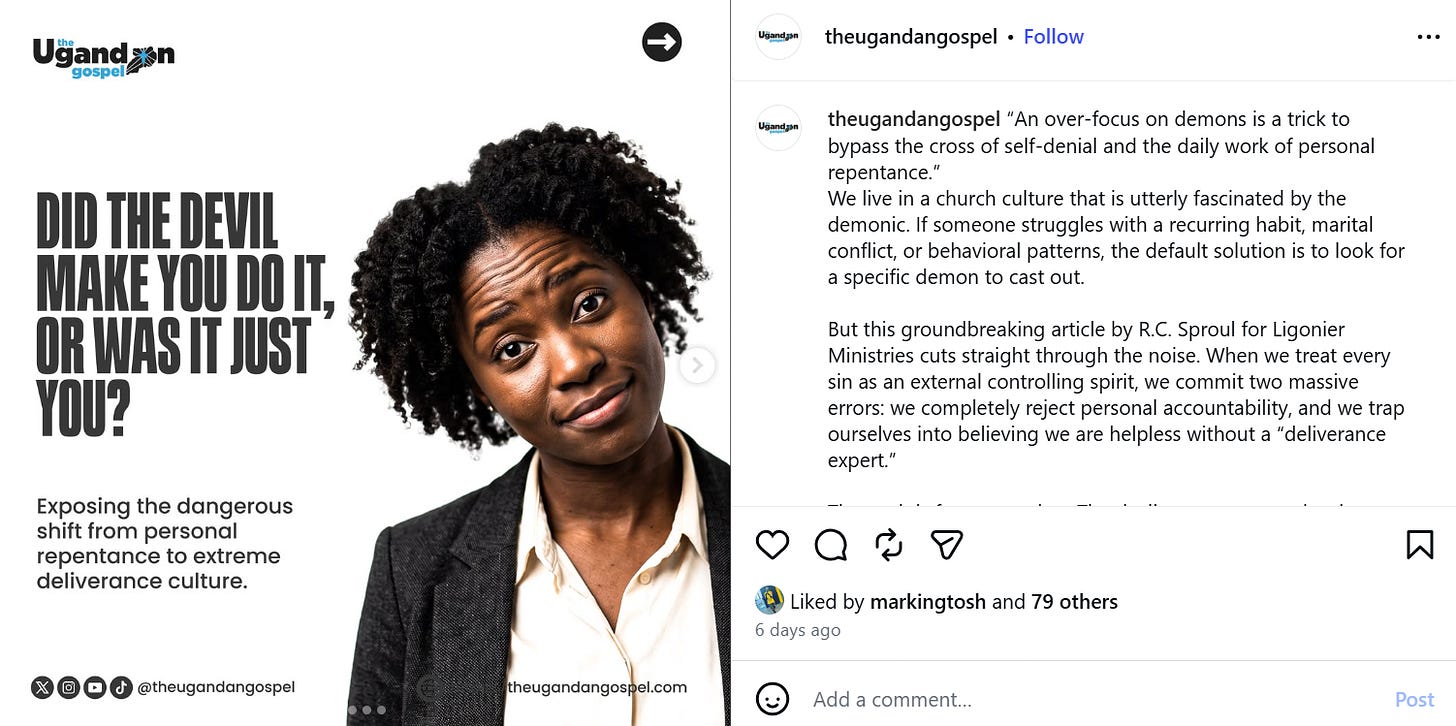
If you are asking, here, briefly, is the trouble with deliverance theology and “ministry” common to many churches in Uganda? Preachers pluck New Testament healing incidents that happened to exclusively announce Jesus’s identity as Son of God, or the early church’s birth, and mix them with traditional African beliefs rooted in “gods blessing you after you present a chicken” (read envelope), after which “the evil spirits tormenting you are chased away, in Jesus‘ name.”
In other words, the pastor becomes the new witchdoctor.
This teaching thrives on uniquely African animalistic fears that say the problems I am facing as a Christian are “unacceptable for believers,” and therefore, some powers somewhere should be summoned to instantly “clean” me up.
I therefore need a second, eighth, and fifteenth deliverance. Of course, deliverance is a biblical word, but in the New Testament, it is communicated as one-time justification, not continual activity to make us acceptable before God, based on our inevitable fluctuating life circumstances.
The teaching basically seizes the insecurity many often Bible-illiterate Christians have, because they have not explored the depths of their identity in Christ and the extent of his finished work at the cross. As the New Testament belabors it.
Deliverance adherents will confess salvation like you and even say, “Jesus died,” but somehow, the miscarriage, the job loss, and the heartbreak need a “special deliverance” where the “spirit husband that has kept you unmarried” is cast out, the devils operating in HR’s office are bound, and the “family curses that have kept your auntie single all this time” are interrupted and “rendered powerless,” before they get to you.
Mind you—to keep it unsuspecting, scattered Bible verses are also cited to back this teaching, which is why gospel clarity is urgent. Which is why the Ugandan gospel documentary is timely.
We desperate congregants love “deliverance/altar/dominion” teachings like these, because they promise to put us in control, determine our prosperity, avoid messy discipleship, excuse our sin and spiritual responsibility, or, on the pastor’s side, they give us spiritual control over so many vulnerable and biblically ignorant people who are only chasing bread and a good life, not Christ. (Which is often our swift way of getting into their wallets too)
That’s why churches fill up each day of the week. Some even meet midweek to specifically exploit regular people’s problems too, like miscarriages, heartbreaks, and marriage. Untrained (or badly trained) pastors keep rousing fears and gospel ignorance to their advantage, as they reward themselves with more audience and “power,” after all, the world keeps churning trouble.
See, these churches don’t fill because “boring” passages like Genesis are opened and explained as God’s sufficient word, in a way that points to the cross, before applying to “self.”
Today’s Ugandan churches fill because Bible passages are manipulated to primarily “soothe/explain your situation/season first” to advance personal agendas among already fearful and biblically ignorant people who are already going through enough.
This is the chief question the Ugandan gospel documentary is getting at: if Christ died once and for all to bring us to God, like many New Testament writers almost repeat themselves, do we need another prayer meeting to “release us from the curse” of singlehood, poverty, another “altar to protect our marriage, contract, and relationship,” or another prayer night to “secure the visa” or “wash off ex-boyfriend spirits?”
Either scripture is wrong, and we are right in our endless “prayer chains, deliverance prayer nights, altars, and nights of blessing,” or Jesus‘s life, death, and resurrection are enough to ground, keep, and secure even a suffering believer in what can’t be added upon—namely, our eternal salvation. But it can’t be both.
No wonder some are already afraid of the release of the Ugandan gospel documentary. Which side should we count you? No need to fear the “true, truth” that will “set you free.”